

That question reframes what many power users already sense: the risk in DeFi isn’t just bad contracts or phishing links, it’s blind signing — approving operations you don’t actually understand. Rabby Wallet addresses this by simulating transactions before they are confirmed, but the simulation is a tool, not a panacea. This explainer walks through how transaction simulation works in a modern multi-chain wallet, what it actually protects you from, where it breaks, and how to install and use Rabby as part of a pragmatic security stack in the US DeFi environment.
I’ll assume you already know basic wallet hygiene (seed phrase isolation, hardware wallets) and instead focus on mechanisms — simulation, approval revocation, gas top-ups and the trade-offs among popular EVM wallets. By the end you’ll have a mental model you can reuse when evaluating wallets or deciding when to trust a transaction.
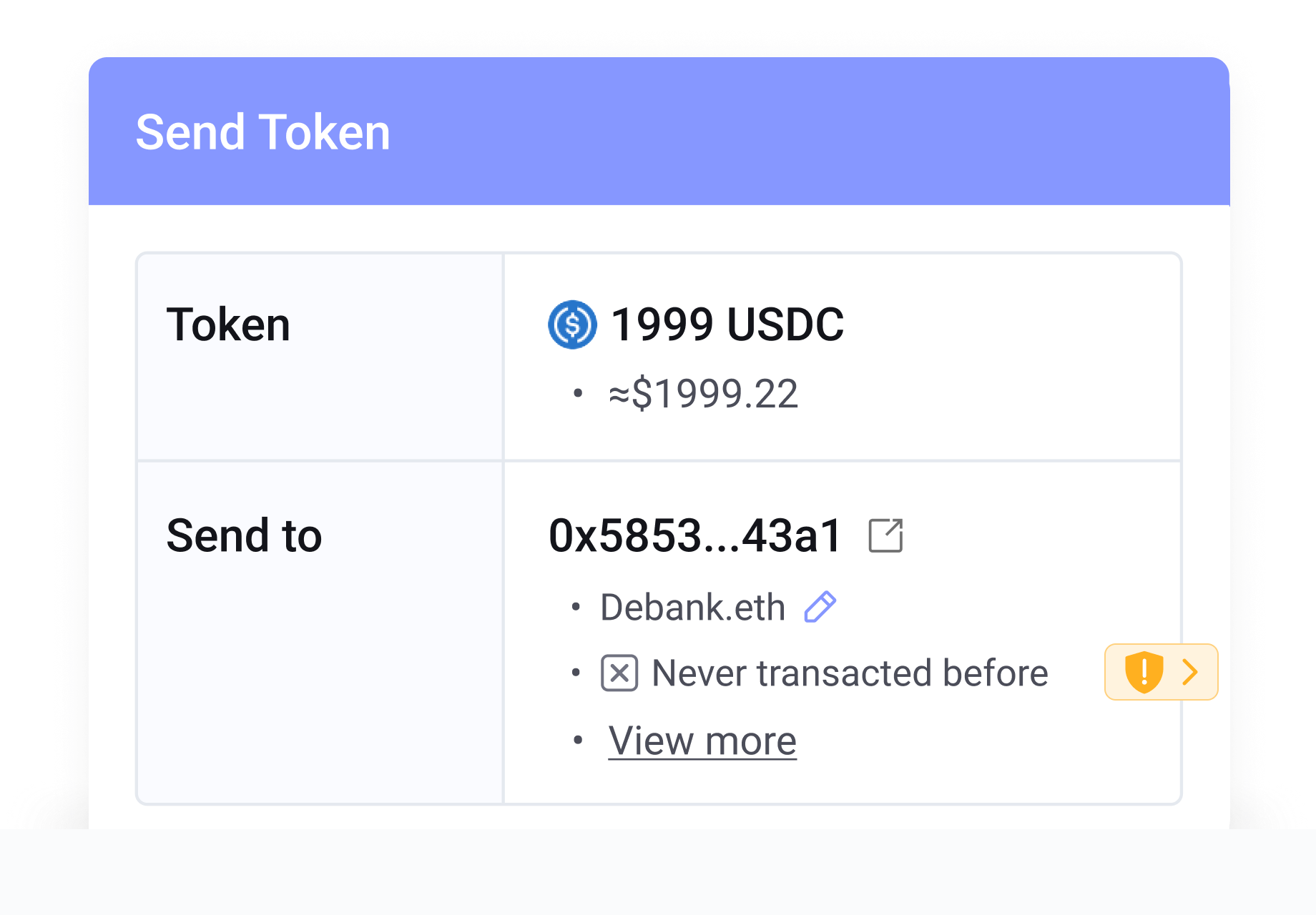
How transaction simulation works — the mechanism, not the magic
At its core, a transaction simulator runs your proposed transaction against a recent copy of on-chain state and returns the expected outcome: token balance deltas, resulting approvals, and gas consumption. It mimics what the network would do if it accepted the transaction at that exact block state. Rabby integrates this as a pre-signing step so users see estimated token changes and fee costs before they click confirm. That prevents a common failure mode: signing a multi-step contract call that, because of complex internal logic, transfers assets you didn’t expect.
Mechanically, simulation depends on three things: an accurate view of current contract state (token balances, allowances, state variables), deterministic execution of the transaction input, and a reliable RPC endpoint to run the simulation. If any of those are stale or manipulated, the simulation can mislead. Rabby reduces those risks by querying well-known networks and displaying the concrete balance outcomes rather than abstract call data.
What simulation gets you and what it doesn’t
Useful protections provided by simulation:
– Visibility into exact token balance changes instead of raw calldata. This is the difference between seeing “approve 0x…” and seeing “you will no longer have 10,000 USDC; contract X will have allowance to spend 10,000 USDC.”
– Fee transparency. Simulations show estimated gas and total fee in native token, so you can avoid surprise costs on higher-fee networks like Ethereum mainnet during market stress.
– Detection of nonsensical recipients or reentrancy-like effects when the simulation indicates funds flow to unexpected addresses, enabling a pre-signing flag.
Important limitations and boundary conditions:
– Simulations are deterministic only with respect to the snapshot they use. A frontrun or MEV bundle inserted between the simulation and the real transaction can change outcome. Simulation reduces blind signing risk but cannot fully eliminate front-running or sandwich attacks.
– Off-chain oracles and time-dependent logic can produce different outcomes at execution. If a contract reads a price feed that updates, the simulation might not match later execution.
– RPC or node compromise can return manipulated state. The user-facing mitigation is transparency — show balance changes and warn when node responses are inconsistent — but the underlying trust assumption remains.
Installing Rabby in practice (short guide for power users)
Rabby is available as a Chromium browser extension, mobile app, and desktop client. For US-based DeFi power users who value hardware-backed keys and institutional workflows, the recommended path is: install the extension on a dedicated browser profile, pair a hardware wallet (Ledger or Trezor), and enable multi-sig or custodial integrations (Gnosis Safe, Fireblocks) for larger pools of capital. You can learn more about the wallet and download options at this page: rabby.
Key practical steps and choices:
– Browser extension install: use a clean Chromium-based profile (Chrome, Brave, Edge) to reduce extension conflicts. Keep the extension updated; Rabby is open-source so updates are auditable but still require attention.
– Hardware wallet pairing: use the extension as a signer only; keep the seed offline. Rabby supports Ledger, Trezor, Keystone and several others, which is crucial for high-value accounts.
– Import vs new wallet: import only if you’re ready to retire an older seed or intend to flip between wallets — Rabby’s Flip toggle makes it convenient to switch default behavior with MetaMask, for example.
Security stack beyond simulation
Simulation is a powerful addition but not everything. Rabby complements simulations with a few companion tools that materially reduce exposure when used together:
– Pre-transaction risk scanning: the engine flags known hacked contracts and suspicious approvals. This is a blacklist-style layer; it helps against known threats but cannot detect novel vulnerabilities.
– Approval revocation: Rabby’s native revocation tool lets you cancel token allowances you no longer need. This minimizes persistent attack surface compared with wallets that leave approvals untouched for months.
– Cross-chain gas top-up: practical when operating multi-chain. If you lack gas on a destination chain, Rabby can facilitate sending gas tokens so simulations and transactions can complete — important for complex cross-chain DeFi flows.
Where Rabby sits among competitors — trade-offs to consider
Compare three common choices: MetaMask, Coinbase Wallet, and Rabby.
– MetaMask: ubiquity and wide dApp compatibility. Trade-off: less built-in simulation and weaker default approval management; requires extensions or manual vigilance for approvals.
– Coinbase Wallet: strong UX and fiat on-ramps (through Coinbase), convenient for users who want simple on/off ramps. Trade-off: less emphasis on transaction simulation and advanced approval revocation, and custodial pathways for some integrations.
– Rabby: specialized for power users with simulation, automatic network switching, and approval revocation. Trade-off: no native fiat on-ramp and no in-wallet staking; you must handle fiat conversion outside or use a companion service. Also remember that Rabby’s past incident (2022 Rabby Swap exploit) shows any wallet ecosystem can be targeted; the team froze the contract, compensated users, and increased audits, which is a responsible response but not a guarantee against future vulnerabilities.
Decision-useful heuristic: when to trust a simulated approval
Use this simple checklist before signing complex transactions:
1) Does the simulation show a concrete token balance delta you expect? If not, hold. 2) Is the recipient a known contract or address? If unknown, research on-chain history. 3) Does the transaction require a large allowance? If so, prefer setting a limited allowance or using approval revocation immediately after the operation. 4) Are market-sensitive oracles involved? If yes, consider timing risk and potential divergence between simulation and execution. 5) If using a browser extension, ensure your RPC provider is trustworthy; consider private RPC endpoints for high-value transactions.
Applied consistently, this heuristic reduces blind signing risk and forces the habit of inspecting outcomes rather than raw calldata.
What to watch next (conditional scenarios)
Signal to monitor #1: widespread adoption of pre-signing simulation across other wallets would raise the bar for user safety, but would also make simulation a commodity — the differentiating advantage shifts to node diversity, UX, and revocation tools. Signal to monitor #2: improvements in on-chain replay proofs or MEV-resistant batching could materially reduce the window between simulation and execution; this would make any simulation more reliable. Signal to monitor #3: integration of fiat on-ramps into wallets like Rabby (currently absent) would change the user flow for US users and raise regulatory and custody questions; if that happens, evaluate whether built-in on-ramps keep non-custodial security guarantees intact.
FAQ
Q: Does Rabby stop all scams and MEV?
A: No. Rabby’s transaction simulation and pre-transaction scanning reduce blind signing and flag known malicious contracts, but simulations are based on a snapshot and cannot prevent front-running, oracle manipulation, or exploitation that occurs between simulation and block inclusion. Use hardware wallets, limited allowances, and consider private or trusted RPCs for high-value trades.
Q: Can I use Rabby with a hardware wallet and Gnosis Safe?
A: Yes. Rabby integrates with Ledger, Trezor, Keystone and supports institutional tools like Gnosis Safe and Fireblocks. This allows you to keep private keys offline while benefiting from Rabby’s UX and simulation features — a common setup for US-based power users managing larger DeFi portfolios.
Q: If a simulation shows no balance change but the contract has complex logic, is it safe?
A: Not necessarily. If the visible outcome is zero balance delta but the contract could later trigger transfers based on other calls or state changes, you need to inspect contract code or rely on third-party audits. Simulation shows the immediate outcome, not all future possibilities triggered by inter-contract interactions.
Closing thought: transaction simulation is one of the clearest, most mechanically intelligible improvements in wallet design in recent years. For US DeFi power users, the correct attitude is pragmatic: treat simulation as a powerful filter that reduces routine blind signing, combine it with hardware keys and approval revocation, and accept that residual risks — MEV, oracle timing, and node integrity — still require procedural defenses. Use the checklist above and, if you want an entry point to test the features described, the wallet details and downloads are available at the linked Rabby page.

Leave a Reply